Project
onwrist.watch
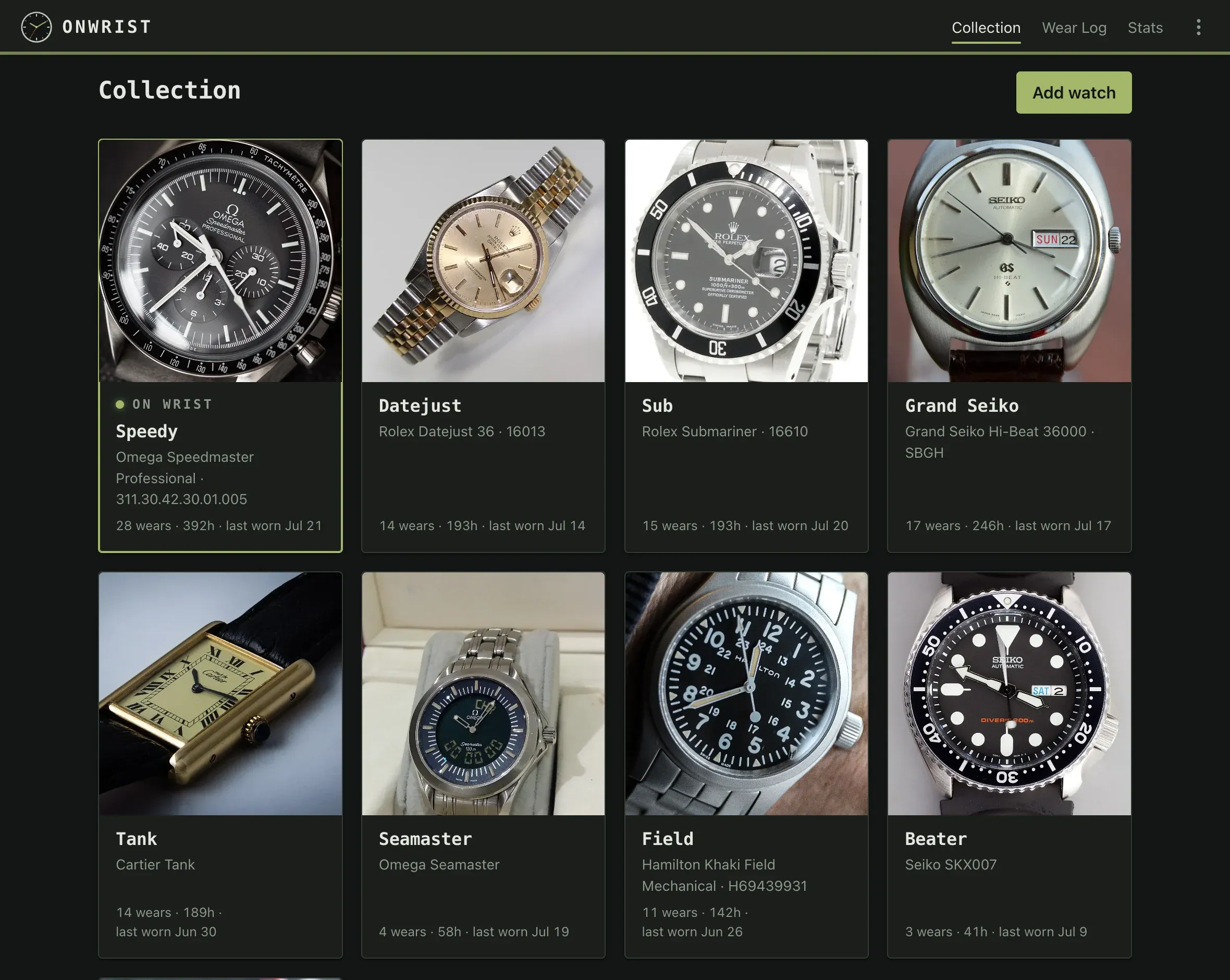
onwrist is a self-hosted watch-collection tracker. You run one SvelteKit app
container plus Postgres with docker compose, sign up, and get three things:
an inventory of every watch you own with photos and specs, low-friction
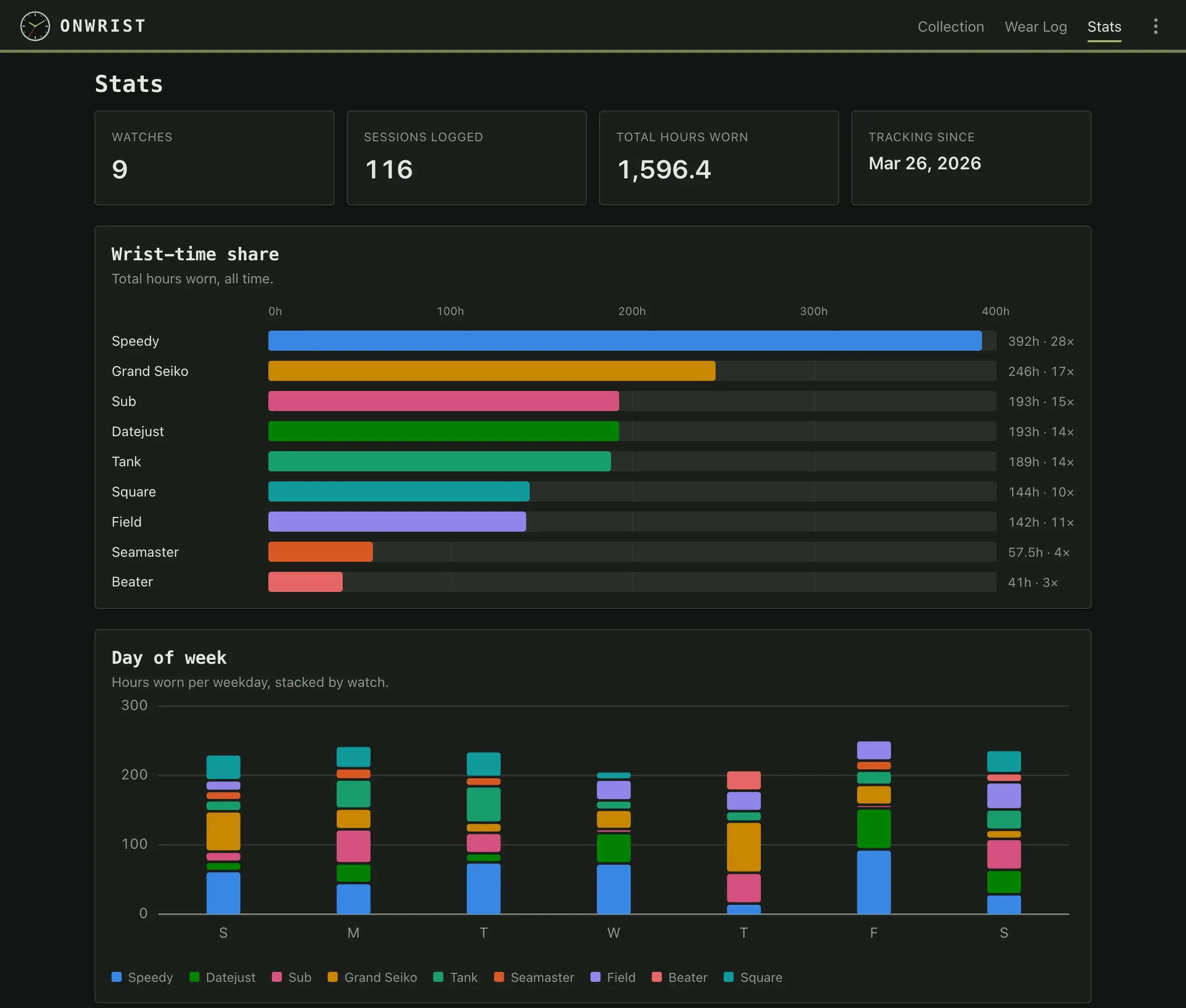
logging of when each watch goes on and comes off your wrist, and a stats
dashboard — day-of-week, time-of-day, total wear, cost-per-wear, calendar
views. It is multi-tenant: self-serve accounts, so a single install can host
more than just me.
The wear logger is the part I actually use every day. Open /log on your
phone, Add to Home Screen, and the installed PWA opens straight to the current
on-wrist state with one-tap put-on, swap, and take-off, plus backfill and
inline corrections. No companion app.
Where it started
The design predates the name. On 2026-07-14 I wrote a spec for a project
codenamed “horolog” — horology plus log — and it was a deliberately smaller
thing than what shipped. Single user. No accounts, no multi-tenancy. SQLite
via Drizzle, one Docker container behind an existing cloudflared tunnel, with
dashboard routes protected by Cloudflare Access and the API guarded by a
single static bearer token. The primary way to log a wear wasn’t even the web
app — it was an iOS Shortcut that made one GET /api/state call and rendered
a menu from whatever the server told it. The web PWA was the fallback and
correction surface.
Then I did something I’d been wanting to try: I handed the build to an
unattended overnight orchestrator. The kickoff instructed a single agent to
execute a 16-task implementation plan via subagent-driven development while I
slept — dispatch a fresh subagent per task, review each result against its
contract and the test suite before moving on, commit and push after every
task, and have a working, tested, seeded app by morning. Sequential tasks
first, the independent middle tasks in parallel worktrees, iPhone verification
explicitly deferred back to me. No Cloudflare wiring — the app had to work with
plain docker compose up and the bearer token alone.
The overnight run went great. What I found in the morning wasn’t a pile of broken tasks — it was a working app whose rough edges were feature adds and polish items that needed some re-work. Fixing and extending something that already runs is a very different morning than debugging something that doesn’t.
What actually shipped
The version at onwrist.watch is meaningfully bigger than horolog’s spec. The
single-user, static-token model became real multi-tenancy: self-serve accounts
with argon2 password hashing and sliding 30-day sessions, so your phone stays
logged in. Signup is gated by a Cloudflare Turnstile captcha that fails
closed — no keys, no signup. Account email (verification, password reset) goes
through Resend, and if you don’t configure it, those links get printed to the
container logs instead, which is fine for a solo install. There’s an admin
console seeded from an ADMIN_EMAIL for user management. SQLite became
Postgres. Photos live on local disk by default but can point at any
S3-compatible private bucket.
The pivot from single-user to multi-tenant wasn’t in a plan. I wanted to see what it would look like — and then I showed it to someone, and they immediately wanted to use it. That’s the whole story: the moment a second person wants an account, “no accounts, no multi-tenancy” stops being a simplifying constraint and becomes the thing you rebuild.
The decisions that survived
For all the growth, the load-bearing modeling choices came straight from that first design doc and made it through intact. The most important one: wear data is stored as sessions, not events. The client speaks in events — put on, swap, take off — and the API translates them into session mutations immediately. A session is a watch, a start time, and an end time that’s null while it’s on your wrist. “What am I wearing right now?” is just the open session; there’s no separate state table to drift out of sync.
Two invariants are enforced in the API on every mutation, including edits and backfills: sessions never overlap, and at most one session is open at a time. That’s what keeps a double-tapped shortcut or a backfill that straddles an existing session from quietly corrupting your history. And the status lines are composed server-side — the client is a dumb renderer of state the server hands it, which is what let the same backend drive both an iOS Shortcut and a web PWA without duplicating the state machine.
Those aren’t aspirations from the design doc — they’re in the shipped code.
The server has an assertNoOverlap that runs on every session mutation, open
sessions participate in the overlap math via an end-of-time sentinel, edits
re-validate, and the invariants even picked up a new dimension the original
design never needed: they’re scoped per tenant, with tests asserting that one
user’s overlap math ignores everyone else’s sessions.
Running it yourself
It’s built to self-host. The tested exposure path is a Cloudflare tunnel:
run cloudflared on the same host, point it at the app’s local port, bind the
app to localhost so the tunnel is the only way in, and you’re done. Any HTTPS
reverse proxy works too. Two things matter regardless. ORIGIN has to be the
exact public URL, scheme and host both — otherwise every form POST is rejected
as cross-site. And rate limiting: by default the app buckets by the connecting
socket’s address, so behind a proxy every request appears to come from the
proxy and all your visitors collapse into one bucket. The fix is to set
ADDRESS_HEADER to a header your proxy always overwrites — and to make the
proxy the only path to the port, so the header can’t be spoofed.